Many French cities, including Paris, Lille, Lyon and Marseille, have been engulfed by riots this autumn. They started with protests by a group of high school kids in a Parisian banlieu against the crumbling infrastructure of their school and teacher shortages. The protest then spread to schools across the country, before sparking a national strike led by the trades union movement in early November. Cars were set alight, shops were looted, and the police were attacked with paving stones and other missiles. The police in turn quelled the crowds with tear gas and water cannons. There were plenty of injuries on both sides, although no reported deaths.
The British media's reporting of the riots compared them to the long line of violent public protests that periodically erupt in France, dating back to the barricades of the French Revolution, through the uprisings in 1830, 1848, and then onto the iconic eventements of 1968, the most romanticised of all the outbreaks of public disorder.
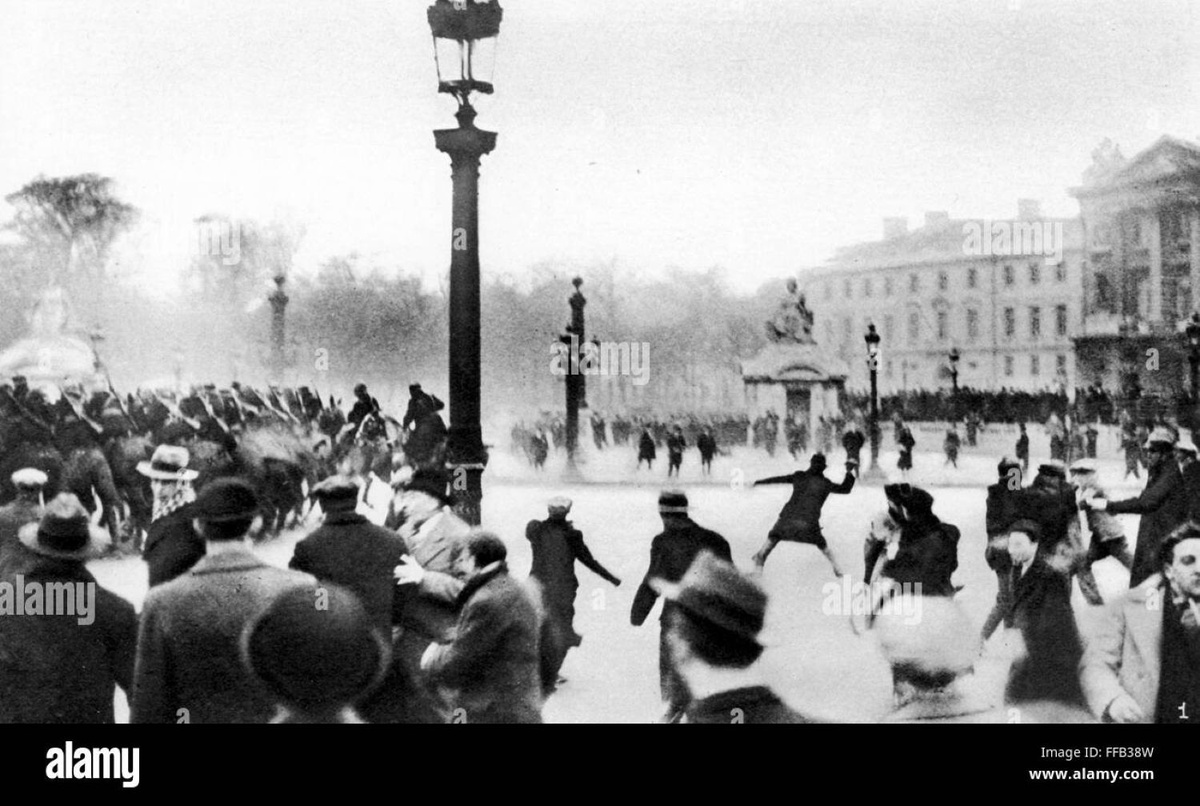
The one riot that always gets left out of this litany of public protests is the one that brought down a government: the demonstration that broke out in Paris on February 6th 1934. One of the reasons that this very violent, and highly effective, outbreak of mass disorder is overlooked is that the main protagonists were from the right of the political spectrum: Action Francaise, Solidarite Francaise, Union Nationale des Combattants and the Croix de Feu. The membership of these groups was mainly drawn from World War I veterans, who were disgusted by the paralysis and corruption of the revolving door of governments that made up the Third Republic. The immediate cause of the riot was the alleged cover up of the Stavisky Affair, a seedy financial scandal, that many felt the government covered up as some of its members were implicated in it. The veterans groups came together to march on the National Assembly, where the politicans had barricaded themselves in.
The violence in 1934 makes the 1968 and 2026 riots look like gentle strolls in the park. The police shot and killed 17 people, 9 of them from the far-right leagues. The day after the riot, the government fell, the only known time that a French government has been brought down by street violence.
The other major consequence of the riot was it led to a major split on the extreme right of French politics. Those who believed that violence was the only route to the establishment of an authoritarian Mussolini style regime went underground to form the Cagoule, The Hooded Men, the subject of my first eponymous novel, the start of The Dark Years trilogy.
The question that haunts modern day France is will these events be repeated after the outcome of next year's Presidential elections. If Marie le Pen wins, will the far left resort to street violence to prevent her from governing? If it is Melechon, from the far left, will the police obey his orders to quell any right-wing backlash?