Pere-Lachaise cemetry in Paris. Famous resting ground for Oscar Wilde, Jim Morrison, Maria Callas, and many more illustrious names from the worlds of culture and politics.
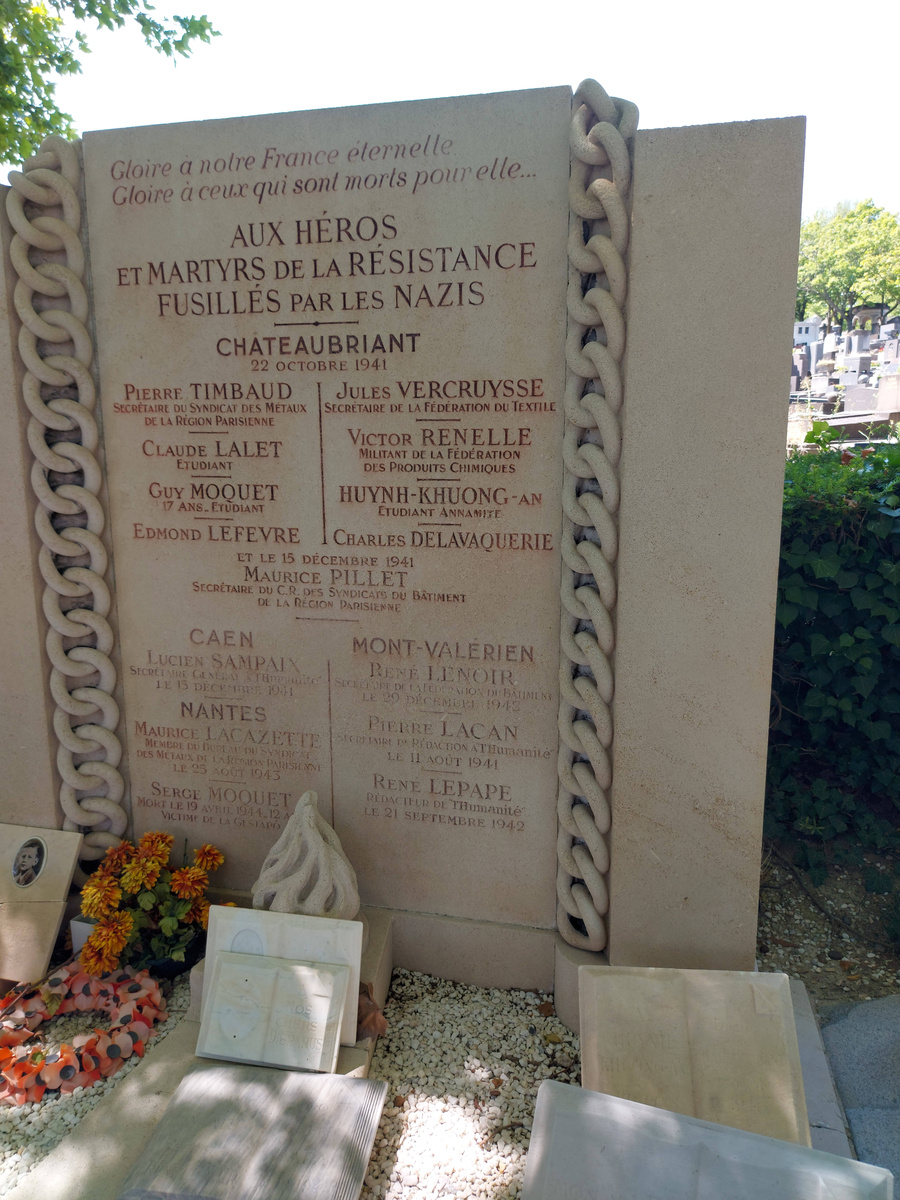
While wandering around the cemetry on a hot July day in 2025, I came across this collective gravestone/memorial to a group of Resistance members who were executed by the Germans in Chateaubriant on October 22 1941. Nothing too exceptional: there are plenty of these memorial stones throughout France. But my eye was drawn to one name in particular on this gravestone, that of Huynh Khuong, described as an Etudiant and Annamite. A student from Indochina.
My interest was perked because at the time I was in the midst of researching the content for Crossing the Lines, the second novel in my Dark Years trilogy. The second half of the book is set in Marseille, where my main character, Antoine Martinet, is sent to work with the Indochinese community in the port city to disrupt the German occupying forces, who entered the city in November 1942, when they extended their occupation from the northern half of France to the rest of the country in response to the Allies' landing in north Africa.
Of course, the French had had an empire in Indochina since the 1870s, and Marseille had been the main port from which French colonialists had sailed to take up their positions as administrators, soldiers and planters in their Far Eastern colony. There had also been a steady trickle of Indochinese people, mainly men, coming in the reverse direction. In the First World War, the French had brought over Indochinese coolies to dig trenches and drive mule trains, as well as fight in colonial regiments (e.g Tirailleurs Tonkinois). By 1940, there were around 25,000 Indochinese living in France, gathered in cities such as Paris, Lille and Marseille, where they worked on the docks and in the factories. Wealthy Indochinese families, particularly among the mandarinate, sent their children to schools and universities in France, so they could learn the French language and prepare themselves for a life as a bureaucrat serving their colonial masters when they returned home.
Huynh Khoung was one of these. He was born in Saigon in 1912. He was the son of a headmaster, so he was from a moderately comfortable background. Huynh was sent to a boarding school in Lyon when he was 12 years-old. He then went onto study literature at Toulouse University. In 1936, the year that the Popular Front government was elected in France, he was the secretary for the Communists' students group in Lyon. He was active in organising strikes among the workers at the Berliet factories in the city. About the same time, he had a child with his partner, Germaine Barjon, who was an organiser for the Friends of the Soviet Union. He moved to Paris to study to become a teacher, eventually taking up a position at a school in Versailles. On June 18 1941 he was arrested at the school by the French police for his communist activities. He was handed over to the Germans, who imprisoned him in the Choisel camp in Chateaubriant. On October 22 1941 he was executed as a hostage in retaliation for the aassassination of a German officer in Nantes (all of this information comes from the Musee de la Resistance de Chateaubriant's website, which has a lovely photo of a smiling and optimistic looking Huynh accompanying the story).
As a novelist (and a historian) I was intrigued and touched by Huynh's story. I used parts of his biography and experiences to inform some of the Indochinese characters in Crossing the Lines. For example, Den Hieu features in the first two novels in the trilogy: the son of a mandarin who gets radicalised as a student in France and then returns to Indochina to become one of the founder members of the emerging Viet Minh, before returning to France in the second world war as an SOE operative. There is also Le Tran, the organiser of the Communist Party cell in Marseille, who works with Antoine to sabotage shipments of grain and weapons on their way to north Africa. One of the tensions for these Indochinese communists is that they were fighting alongside the French to defeat the Germans, knowing that as soon as that was accomplished they would turn on the French to get them out of Indochina. But, during World War Two, their primary loyalty as communists was to defend the Soviet Union, their ideological motherland.
I like to think that if Huynh-Khoung had not been executed in a sand quarry in Chateaubriant in 1941, he would have found himself in the early 1950s back in Vietnam expelling the French from his homeland.